
Home » Therapy Guides » Understand the Different Attachment Styles
Understand The Different Attachment Styles
Attachment styles shape how we connect, trust, and feel secure in relationships. Learn the four attachment styles and what they mean for you.
What are Attachment Styles?
Attachment styles describe the patterns people develop for connecting with others emotionally. They come from attachment theory, a psychological framework developed by John Bowlby that explains how early relationships with caregivers shape how we relate to others throughout life.
Your attachment style influences how you approach intimacy, respond to conflict, express needs, handle uncertainty, and build trust in relationships. These patterns often show up most clearly in close relationships, especially romantic ones, but they also affect friendships, family dynamics, and even work relationships.
It is important to understand that everyone has an attachment style. Attachment styles are not diagnoses, personality flaws, or signs that something is “wrong” with you. They are learned relationship patterns that develop as adaptations to early experiences. Research suggests that roughly 50–60% of adults develop secure attachment, while others develop forms of insecure attachment, including anxious, avoidant, or fearful-avoidant styles.
All attachment style differences are organized around two core dimensions. The first is attachment anxiety, which reflects how much someone worries about abandonment, rejection, or losing closeness. The second is attachment avoidance, which reflects how comfortable
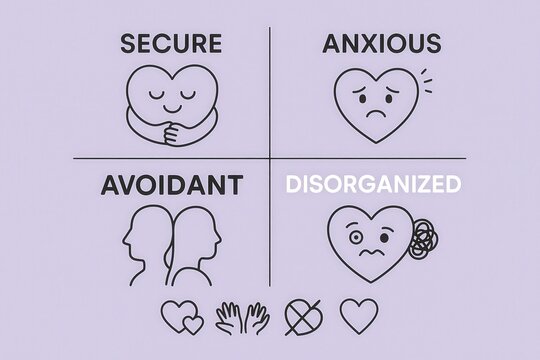
The Four Attachment Styles at a Glance
Attachment styles fall into four broad patterns. This quick overview is designed to help you recognize which style or combination of styles might feel most familiar to you or someone you care about.
Secure Attachment: People with secure attachment feel comfortable with both closeness and independence. They generally trust others, communicate their needs openly, and handle conflict without excessive fear of abandonment or withdrawal. Secure attachment reflects low anxiety and low avoidance in relationships.
Anxious Attachment: People with anxious attachment tend to fear abandonment and seek frequent reassurance. They may feel uneasy when alone, overanalyze relationship signals, and worry about their partner’s availability or commitment. This style is marked by high anxiety and low avoidance.
Avoidant Attachment: People with avoidant attachment value independence and often feel uncomfortable with emotional closeness. They may downplay their needs, keep others at a distance, or withdraw during conflict. This style reflects low anxiety but high avoidance of intimacy.
Fearful-Avoidant Attachment: People with fearful-avoidant attachment want closeness but also fear being hurt or rejected. They may send mixed signals, pull others close and then push them away, and feel conflicted in relationships. This style combines high anxiety and high avoidance.
As stated, approximately 50–60% of adults have a secure attachment style. The remaining 40–50% fall into one or more insecure attachment patterns, including anxious, avoidant, or fearful-avoidant. Insecure attachment is common and does not mean something is wrong with you or that you’re broken.
It’s also important to note that attachment styles are not rigid categories. Many people show traits from more than one style, and attachment patterns can shift depending on the relationship or life stage. Understanding attachment styles is about recognizing patterns, not labeling yourself permanently.
Secure Attachment Style (The Healthy Baseline)
Secure attachment is the healthy baseline for relationships. It is defined by comfort with both emotional closeness and independence, trust in others, and low fear of abandonment or intimacy. Securely attached people generally see themselves as worthy of love and view others as reliable and responsive, allowing them to balance connection with autonomy.
In relationships, secure attachment shows up as open communication, emotional availability, and comfort with vulnerability. Securely attached individuals can express needs and feelings without excessive fear, handle conflict constructively, and respect their partner’s independence. They enjoy closeness without becoming preoccupied and can be alone without distress.
Secure attachment is supported by strong emotional regulation. These individuals can self-soothe, tolerate difficult emotions, and recover relatively quickly from disagreements or setbacks. They do not rely on constant reassurance to feel secure, but they are able to ask for support when needed.
At the core of secure attachment are positive internal beliefs about self and others. Securely attached people tend to believe “I am worthy of love” and “Others can be trusted,” creating a sense of psychological safety across relationships.
Secure attachment often develops from consistently responsive and emotionally attuned caregiving in childhood, where needs are met predictably and emotions are accepted. However, secure attachment is not limited to early life. It can be developed at any age through increased self-awareness, supportive relationships, and therapies such as cognitive behavioural therapy or attachment-focused therapy.
Anxious (Preoccupied) Attachment Style
Anxious attachment is marked by a strong fear of abandonment and a constant need for reassurance in close relationships. People with this style often worry that their partner cares less than they do and may interpret neutral behaviors, such as delayed responses or changes in tone, as signs of rejection. Their attention is frequently preoccupied with the relationship and its security.
In relationships, anxious attachment often shows up as a pursuit for closeness and validation. This may include frequent checking of a partner’s availability, feeling distressed by small withdrawals, or fearing that conflict means the relationship is ending. Many anxiously attached people try to maintain connection through people-pleasing or over-accommodation and are often misunderstood as “too needy” or “clingy,” even when expressing normal attachment needs.
Internally, anxious attachment is associated with chronic worry, low self-esteem, and difficulty self-soothing. Emotional stability often depends on reassurance from a partner, and self-doubt can persist even in supportive relationships.
Anxious attachment commonly develops in response to inconsistent or unpredictable caregiving in childhood, where emotional needs were sometimes met and sometimes ignored. Over time, this teaches the belief that closeness must be actively pursued to feel secure.
Anxious attachment affects an estimated 5-10% of adults, though prevalence varies by culture, and it is associated with higher rates of anxiety and depression when unaddressed.
Avoidant (Dismissive) Attachment Style
Avoidant attachment is marked by discomfort with emotional closeness, a strong preference for independence, and reliance on self-sufficiency. Rather than fearing abandonment, avoidantly attached people often experience intimacy as threatening to their autonomy. Emotional distance feels safer than dependence on others.
In relationships, avoidant attachment commonly shows up as pulling away when things become emotionally close. This may include difficulty expressing feelings, withdrawing during conflict, minimizing a partner’s needs, or ending relationships when deeper commitment is required. Avoidantly attached individuals often appear calm, independent, and unaffected, even as partners experience them as emotionally distant.
Internally, avoidant attachment is not the same as emotional indifference. Research shows that avoidantly attached people often experience heightened physiological stress during emotional closeness, even if they are not consciously aware of it. Over time, they learn to suppress emotions so effectively that they lose touch with them, which can lead to unacknowledged loneliness.
Avoidant attachment typically develops in response to emotionally unavailable or dismissive caregiving in childhood, where emotional expression was discouraged. This teaches the belief that emotions are unsafe and that self-reliance is necessary for protection.
Avoidant attachment affects about 22% of adults, making it one of the most common insecure attachment styles in North America. It has been linked to emotional numbness, depression, chronic loneliness, and difficulty forming deep, lasting connections.
Fearful-Avoidant (Disorganized) Attachment Style
Fearful-avoidant attachment, also called disorganized attachment, combines high anxiety with high avoidance. People with this style want closeness but also fear it, creating an internal conflict where connection feels both necessary and unsafe. This tension often leads to unpredictable push-pull behavior in relationships.
Unlike anxious attachment, which primarily pursues closeness, or avoidant attachment, which prioritizes distance, fearful-avoidant attachment alternates between the two. Individuals may seek reassurance, then withdraw or shut down when intimacy feels overwhelming, which can be confusing for both partners.
In relationships, this pattern often appears as sudden shifts between closeness and distance, difficulty trusting even reliable partners, and high emotional volatility. Some people remain in chaotic relationships because the dynamics feel familiar, while others leave relationships abruptly without fully understanding why.
Internally, fearful-avoidant attachment is associated with intense emotions, difficulty regulating or identifying feelings, and deep fears of both abandonment and engulfment. Many people with this style carry shame around their needs, making the internal experience exhausting and destabilizing.
Fearful-avoidant attachment typically develops in response to early trauma, abuse, or frighteningly inconsistent caregiving, where caregivers were both a source of comfort and fear. Research suggests that approximately 5–10% of adults exhibit fearful-avoidant attachment patterns.
Because of its strong links to trauma, this attachment style often benefits most from trauma-informed, attachment-focused therapy that prioritizes safety, emotional regulation, and trust over time.
How Attachment Styles Manifest in Adults
Attachment styles do not show up the same way in every relationship. How you attach often depends on the other person, the emotional safety of the relationship, and your shared history.
Context-Dependent Attachment
It is common for someone to feel securely attached with close friends, anxiously attached in romantic relationships, and more avoidant with family members. Different relationships activate different attachment patterns based on past experiences and current dynamics.
Why Relationship Dynamics Matter
The level of safety, consistency, and emotional responsiveness in a relationship shapes which attachment behaviors emerge. Someone with anxious tendencies may feel secure with a responsive partner but become anxious with a partner who is distant or unpredictable.
Cross-Relationship Awareness
Looking at patterns across romantic relationships, friendships, family, and work can offer important insight. When the same behaviors repeat across many relationships, they often reflect a core attachment style. When patterns vary widely, attachment responses are more likely to be situational.
The Multiplicity Perspective
Many people do not fit neatly into a single attachment category. It is normal to be secure in some relationships and insecure in others, such as feeling avoidant with parents but secure with a partner. This flexibility reflects the complexity of human attachment, not inconsistency or dysfunction.
Can Attachment Styles Change?
Attachment styles can change and often do, as they are learned patterns rather than fixed personality traits. So, they are not permanent. Attachment styles developed as adaptive responses to earlier relationships, which means the nervous system can learn new ways of relating.
People can move from insecure attachment toward greater security through therapy, consistently safe relationships, and intentional practice. The brain is neuroplastic, allowing repeated experiences of safety and responsiveness to reshape long-standing beliefs about trust and self-worth.
However, change happens gradually. Someone with anxious attachment may first learn to self-soothe and set healthier boundaries, then feel less dependent on reassurance. Someone with avoidant attachment may start with small moments of vulnerability, gradually increasing comfort with emotional closeness and awareness.
Shifting attachment patterns takes time and commitment, often months or years rather than weeks. However, this effort typically leads to meaningful improvements in relationship quality, emotional regulation, and mental health.
Therapy is the most effective pathway for change. Attachment-informed approaches such as cognitive behavioural therapy, emotionally focused therapy, internal family systems, or schema therapy support deep nervous system change.
The goal is not perfection, but flexibility. Secure attachment means being able to regulate emotions and respond intentionally, even when anxiety or distance arises.
The Importance of Understanding Attachment Styles
Understanding attachment styles provides a framework for making sense of your emotions, relationships, and long-standing patterns with greater clarity and compassion.
Reduces Shame and Builds Self-Compassion
Understanding attachment styles reframes insecurity as a learned response rather than a personal flaw. This shift from shame to curiosity makes growth and healing feel possible instead of overwhelming.
Explains Repeating Relationship Patterns
Attachment awareness helps people recognize why certain dynamics keep showing up in their relationships. Questions like “Why do I always feel anxious?” or “Why do I pull away when things get serious?” finally have a clear explanation.
Improves Communication and Empathy
Seeing behaviors through an attachment lens helps people understand that withdrawal or pursuit reflects nervous system responses, not lack of care. This reduces blame and allows couples to talk about patterns rather than personal attacks.
Strengthens Mental Health Treatment
Many experiences of anxiety and depression are connected to unresolved attachment wounds. Addressing attachment directly often leads to more effective and lasting mental health outcomes.
Enables Intentional Growth
Knowing your attachment style allows you to practice new responses, choose healthier relationships, and engage in therapy with greater clarity. Awareness turns unconscious reactions into intentional choices.
Supports Healthier Relationships Overall
Attachment insight improves romantic relationships, friendships, and family dynamics. It increases empathy, reduces emotional reactivity, and supports more secure, balanced connections across all areas of life.
Schedule a Free Consultation
If any of these patterns sound familiar, you’re not alone and you don’t have to work through them yourself. At Supportive Therapy, we work with individuals to understand their attachment style, build emotional security, and create healthier relationships. Book a free consultation to take the next step toward feeling more grounded and connected.
Frequently Asked Questions
Yes, many people display different attachment styles in different relationships. You might be secure with close friends but anxious romantically. Attachment is context-dependent and influenced by the other person and relationship dynamics.
Secure attachment is most common, with 50-60% of adults securely attached across cultures. The remaining 40-50% split among anxious, avoidant, and fearful-avoidant styles, though rates vary significantly by culture and country.
Fearful-avoidant isn’t instability; it’s a rational nervous system response to chaotic/traumatic childhood, where closeness was both needed and dangerous. The push-pull makes sense given their history. It’s adaptive, not pathological.
As a relationship becomes more consistently safe and responsive, someone with insecure attachment often gradually shifts toward more secure patterns. A secure partner’s stability can help an insecure partner feel safer over time.
Yes, anxious attachment patterns show up in all relationships—friendships, family, professional relationships. Someone might seek excessive reassurance from friends, struggle when friends have other relationships, or avoid conflict to prevent abandonment.
Yes, if you’re comfortable, telling your partner about your attachment style can be very helpful. Many couples find discussing attachment styles increases understanding and reduces blame (“You’re distant” becomes “Your avoidant patterns are activated”). Shared language facilitates more compassion and communication.